October 31, 2026 · Indumor
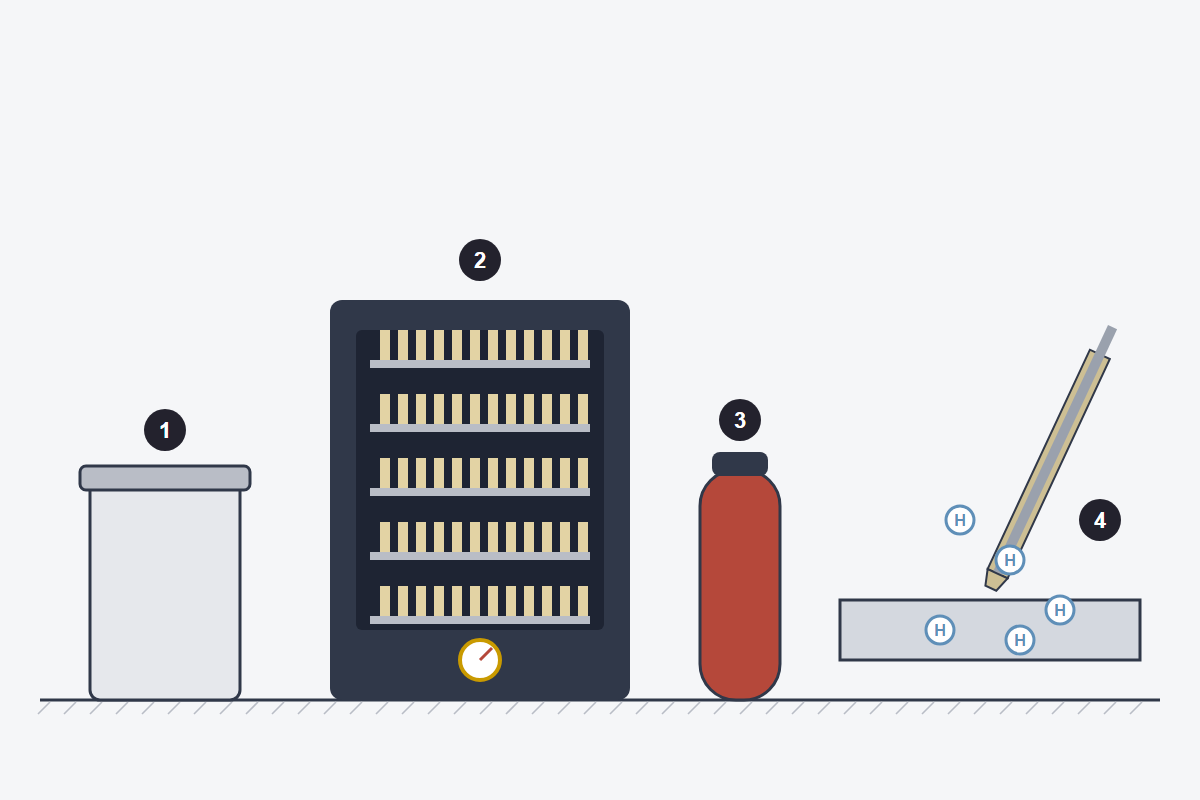
In the drawing: 1 factory-sealed container, 2 holding oven, 3 portable rod oven at the station, 4 hydrogen from the damp covering passing into the pool and the heat-affected zone.
A wet low-hydrogen rod is a crack waiting to happen.
It sounds like an exaggeration until you see where the trouble comes from. The covering of a low-hydrogen electrode such as the E7018 absorbs moisture from the air. In the arc, the water breaks down, the hydrogen dissolves in the pool and, as it cools, gets trapped in the steel. This lesson explains what happens next and how to prevent it.
Trapped hydrogen moves through the metal and gathers where the steel ended up hard and stressed, especially in the zone next to the weld. When three things coincide, hydrogen, a hard microstructure and stress, a cold crack appears. The treacherous part is that it can take hours or days to show up, after the part has passed visual inspection. That is why, on high-strength steels, many procedures call for waiting a day or two before inspecting. Ordinary steels in thin sections tolerate quite a lot; higher-strength steels, heavy parts and rigid joints, very little. Thin sheet of ordinary steel almost never shows the problem; a thick, restrained crane girder can.
Low-hydrogen rods come in cans or vacuum packs, and while sealed they stay dry. Once opened, they go into a holding oven kept above 120 °C (250 °F), and leave it a few at a time. At the station, portable rod ovens keep them warm. The holding oven stays on all the time, weekends included, if there are electrodes inside. Out of the oven the clock runs: AWS D1.1, for example, allows up to four hours for an E70XX, less for the higher-strength classes, and somewhat more for the ones carrying the R for moisture resistance. A rod oven is not for warming up lunch, although in more than one shop it does both jobs.
If a low-hydrogen rod has been out longer than allowed or got wet, it is rebaked at high temperature, usually between 260 and 430 °C (500 and 800 °F) for one or two hours, as the maker specifies on the box. Many procedures allow this only once. The rebaking oven is not the holding oven: it reaches much higher temperatures and is loaded in batches, with the rods in thin layers so the heat reaches them evenly. An electrode with a cracked or loose covering, or one that really got soaked, cannot be saved: it gets scrapped. Rebaked rods go back into the holding oven, not straight to the welder.
A low-hydrogen rod that picked up moisture gives warnings, though not always in time. The arc sounds harsher and crackles, porosity appears especially at the start, and sometimes visible steam comes off the covering as it heats. If the covering blisters, cracks or flakes off, the electrode is beyond saving. The problem is that the moisture needed to crack a high-strength steel does not always show in the bead: that is why time out of the oven is controlled, rather than trusting your eyes. A low-hydrogen rod left out in a humid shop can take on enough moisture in a few hours to stop being low-hydrogen.
On a job with a procedure, the oven has its log: the temperature gets recorded and the opened can carries the time written on it. Welders take out only what they will use within the allowed hours, in their portable oven, and whatever is left goes back in before the time runs out. A rebaked electrode is marked so it is not rebaked twice. Some vacuum packs are designed to be used without rebaking once opened, within the time the maker states, and they make field work much simpler.
When the cracking risk is high, control continues after welding. Preheat helps because the part cools more slowly, the zone next to the weld ends up less hard and the hydrogen has time to escape. Some procedures add a post-heat: keeping the joint hot for a while after finishing, so the hydrogen leaves before the part reaches room temperature, which is when the crack appears.
Rutile rods are kept in a dry, warm place, and they do not go into the low-hydrogen oven: if they got very damp, they are dried at low temperature as the maker indicates. Cellulosic rods, such as the E6010, need to keep some moisture in the covering to burn properly, so they are not oven-dried either. Mixing the three families on the same shelf is asking for trouble.
When you open the next can of low-hydrogen rods, write the time on the lid with a marker. It is the cheapest control there is against hydrogen cracking. To keep going: what the covering does, welding defects, and how Indumor handles welding.
Think of the answer before you open it.
Hydrogen in the metal, a hard microstructure near the weld and stress.
Above 120 °C (250 °F), in a holding oven.
Up to four hours; less for higher-strength classes and somewhat more for those with the R suffix.
Because they need some moisture in the covering to burn properly.
We work higher-strength steels to the procedure they call for.
© Indumor 2010–2026 — Industrial steel fabrication, Córdoba, Argentina
