October 31, 2026 · Indumor
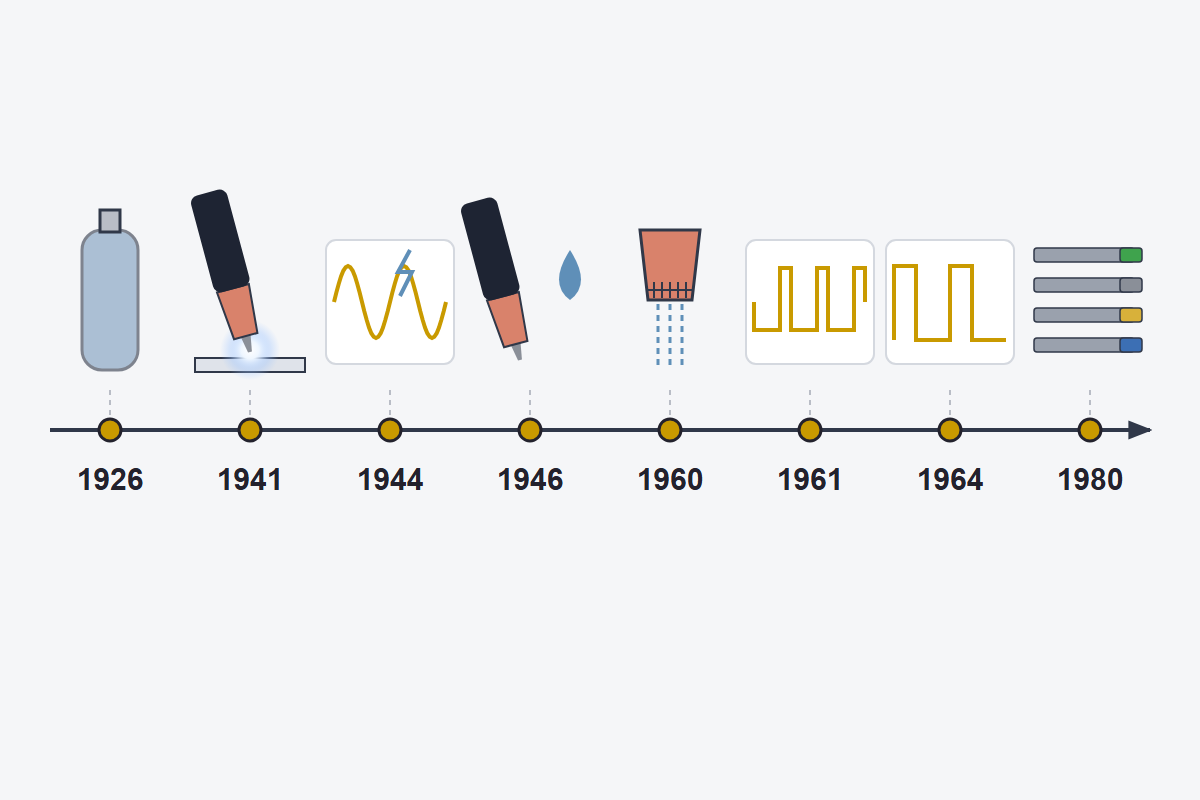
1926 arcs in helium and argon · 1941 the Northrop torch · 1944 AC with high frequency for aluminum · 1946 water-cooled torch · 1960 gas lens · 1961 square wave · 1964 pulsed TIG · 1980 thorium-free tungstens in the standards.
TIG was born for an airplane that never saw combat.
In June 1940, Northrop received a US Army contract to study an experimental fighter, the XP-56. The team chose magnesium for the structure and the skin: it weighed about a third less than aluminum, and at the time there were fears that the country's aluminum would not stretch to everything ahead. The problem was how to join it. Airplanes were riveted, and magnesium is an unkind metal to weld: it burns in almost any gas containing oxygen or nitrogen, it softens and sags when heated, and the fluxes then used for light metals corroded it. The 1941 patent itself would note how desirable a smooth upper surface is in aircraft construction, something rivets do not give.
Jack Northrop had hired Vladimir Pavlecka, a Czech-born engineer he had worked with before, as head of research. According to the Smithsonian, it was Pavlecka who developed the welding system and tried to patent it, with no luck: General Electric had patented the inert-gas-shielded arc back in the 1920s. In June 1926, two of its engineers, Henry M. Hobart and Philip K. Devers, had filed patents for wrapping the arc in helium and in argon, and the same company had already tried tungsten in hydrogen-shielded arcs. What Northrop could patent was the torch.
The patent was filed on January 4, 1941, in the name of Russell Meredith, and granted on February 24, 1942. Its claims describe a torch with a centered refractory electrode, a gas space around it and a flared nozzle that avoids drawing in air. The rest is in the description: helium at low pressure, a pointed tungsten rod that the arc melts into a small ball, direct current from a generator, 65 to 140 A for sheet 1 to 4.6 mm thick, a magnesium filler rod with no flux and a grooved copper backing. It says nothing about argon, alternating current or high frequency. Some histories credit Meredith alone and others a team with Pavlecka and Tom Piper; the patent says Meredith. The process was named Heliarc, for helium and arc.
And the airplane? The first prototype was delivered late, in March 1943, and flew that same year; the second, in March 1944. It never went into production. The process invented for it, on the other hand, went into industrial use from the early 1940s.
Around 1942 or 1943 Northrop handed the rights to the industrial gas division of a large US chemical group; the records differ on whether it was a sale or a license. What came next was a long list of improvements. Meredith's second patent, filed in 1943, already spoke of "helium or argon". In February 1944, Richard F. Wyer of General Electric filed for welding aluminum with alternating current under argon or helium: he found that the arc behaved like a rectifier, passing more current one way than the other, and solved it with very high open-circuit voltages or with superimposed high frequency. His patent already mentioned thoriated tungsten. In December of that year, Wilber B. Miller filed another, with high frequency of at least 2,000 volts and thousands of cycles per second. That is where aluminum TIG was born.
By the mid-1940s argon had displaced helium. The usual story is price, but there were several causes: the United States had barred helium exports under a 1925 law, argon could be had anywhere, and on AC it needed far less voltage to keep the arc alive. Outside the United States, gas was the big obstacle for years: according to the Polish history of the process, in the mid-1950s local argon lacked the purity needed and imported argon cost more than twice as much as CO₂, and in 1959 the whole country had fifteen argon welding machines. In 1946 the water-cooled torch was patented; in 1960 came the gas lens, a fine-pored barrier that straightened the stream and stretched it from about half an inch to three inches or more; in 1962, hot wire. The angled-head torch for awkward corners had been filed for in 1951, and plasma welding, a TIG arc squeezed through a cooled nozzle, followed in 1955. In 1961, in a patent assigned to the US Atomic Energy Commission, Thomas B. Correy filed for square-wave AC, with the positive part of the cycle cut to a quarter or less: the balance idea every machine has today, and in 1975 a thyristor source that let the welder adjust it was filed for.
The tungstens changed too. The first was pure. Thoriated tungsten appears in Wyer's 1944 patent, and by 1952 there was already a study of its hazard, because thorium is mildly radioactive. Ju-Zhen Wang, of a lamp factory in Shanghai, proposed a tungsten with cerium oxide to replace it; China's delegate took the proposal to ISO in 1980, and the US patent followed in 1987. In that same year of 1980, a Soviet standard already included tungstens with lanthanum and yttrium. There is no single inventor of lanthanated tungsten, now one of the most widely used.
Thorium is not a period curiosity: in plenty of shops thoriated tungsten is still ground without extraction, and that dust is not something to breathe.
Pulsed TIG has two origins. Pulsed arcs were in use in the Soviet Union from 1960, and in 1964 engineers at a US boiler company filed for a TIG process with slow pulses to weld tubes to tube sheets, which did away with lack of fusion. Activated-flux TIG was born at the Paton Institute in Kiev, first published in 1965, and it allows single-pass penetration of up to about 12 mm (1/2 in) of stainless, against some 3 mm with ordinary TIG. And in the 1960s the aerospace industry drove automatic orbital tube welding, the method that now welds sanitary piping. Keyhole TIG, a different variant that opens a hole through the joint with a high-current arc, came much later, from Australia.
Nearly all of it lives on in today's machines. The torch with its tungsten and its gas is the 1941 one; argon, AC with high frequency and the balance knob come from the 1940s and from 1961; the gas lens from 1960; lanthanated tungsten from the standards of 1980. At Indumor we TIG weld stainless, aluminum and pipe roots: if you have a part like that, write to us and we will send you a quote. To keep going: tungstens and AC, in this course; the history of MIG-MAG; where argon and helium come from; and the beginnings of the electric arc, in another of our histories.
Sources: US patents 1,746,081 (Hobart), 1,746,191 (Devers), 1,746,196 (Langmuir and Alexander), 2,274,631 and 2,376,265 (Meredith), 2,474,023 (Wyer), 2,475,357 (Miller), 2,468,806 (Pilia), 3,053,968 (Gorman and Nelson), 3,122,629 and 3,163,743 (Manz; Wroth, Reis and Manz), 3,068,352 (Correy), 4,038,515, 3,390,250 and 4,678,718 (Wang); Smithsonian National Air and Space Museum (Northrop XP-56); TWI; IARC Monograph 118 (2018); GOST 23949-80 standard; Howse and Lucas (TWI, 2000); A. P. Litvinov, The Paton Welding Journal (2009); A. Pocica, Biuletyn Instytutu Spawalnictwa (2019).
Think of the answer before you open it.
Northrop's XP-56, an experimental fighter with a magnesium structure and skin that never went into production.
Because General Electric had already patented the inert-gas-shielded arc in the 1920s (Hobart with helium and Devers with argon).
That the arc behaved like a rectifier; he solved it with very high open-circuit voltages or superimposed high frequency.
From China: Ju-Zhen Wang, of a lamp factory in Shanghai, proposed it to replace thoriated tungsten; the proposal reached ISO in 1980.
Stainless, aluminum and pipe roots, in our shop in Córdoba, Argentina.
© Indumor 2010–2026 — Industrial steel fabrication, Córdoba, Argentina
