October 31, 2026 · Indumor
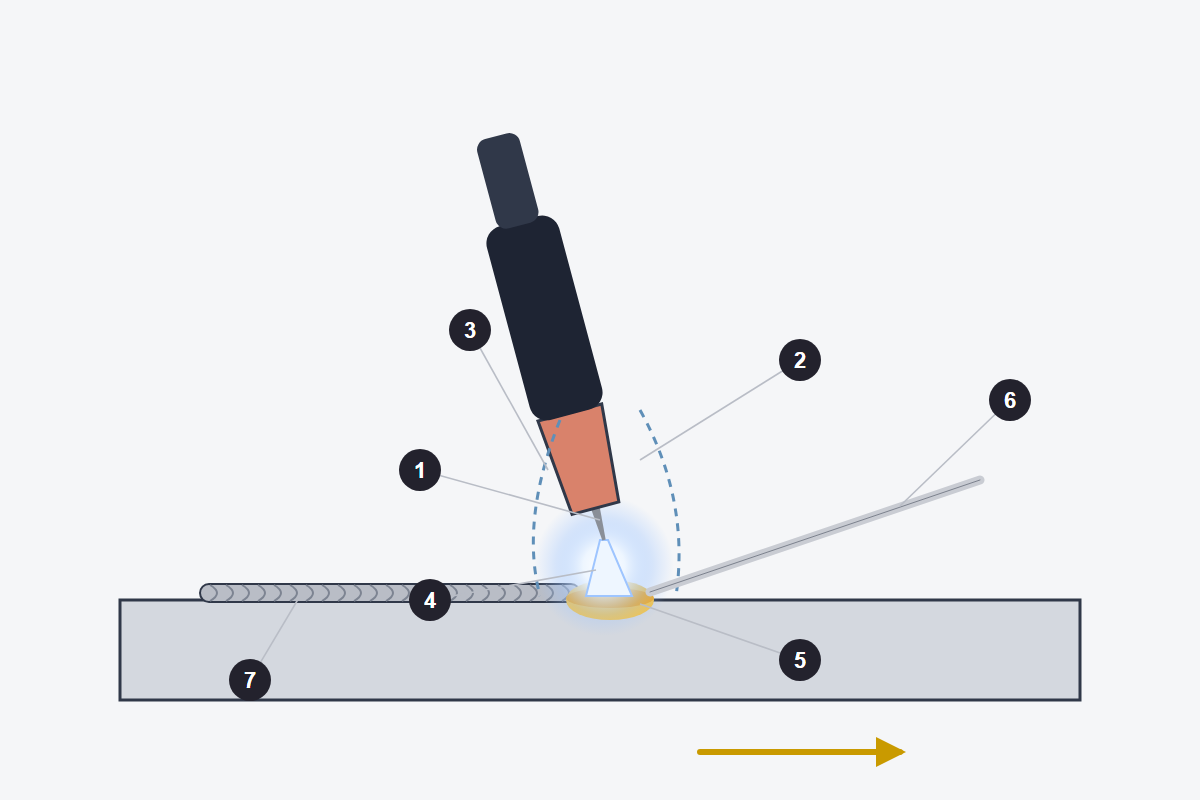
In the drawing: 1 tungsten electrode, which does not melt, 2 ceramic cup, 3 shielding gas, 4 arc, 5 weld pool, 6 filler rod entering from the front, 7 bead.
Tungsten melts at about 3,400 °C (6,150 °F), the highest melting point of any metal. That property is what makes TIG possible: an arc that comes from an electrode that does not wear away, shielded by inert gas, while the other hand adds filler metal only when it is needed. It is the cleanest and most controllable process used in a shop.
The torch holds a tungsten electrode surrounded by a cup, usually ceramic, through which argon flows. The arc is struck between the tungsten tip and the work, it melts a small pool, and the free hand brings a filler rod to the edge of the pool. Heat and filler are handled separately: the welder can melt without adding metal, add a lot or a little, and go as slowly as the part needs. The power source runs at constant current, like a stick welder, and the current is often adjusted on the fly with a foot pedal. ISO 4063 numbers it process 141, and North American codes call it GTAW, short for gas tungsten arc welding.
When the edges are fused with no rod at all, it is called autogenous TIG; when the torch rides on a carriage or on a head that travels around a tube, mechanized or orbital TIG. It is also the process for the thinnest gauges, down to a few tenths of a millimeter, where any other arc would burn through.
Against MIG-MAG, TIG loses on speed by a wide margin. It deposits a fraction of the pounds per hour, takes both hands and sometimes a foot, and needs a welder with more practice behind them. It also asks for clean metal: rust, paint or oil that a MIG arc would push through turn into porosity under a TIG torch. For filling heavy carbon steel joints in a structural shop it makes no sense.
It wins wherever the quality of every inch matters. It does not spatter, leaves no slag, and the bead comes out clean and even. It welds very thin sheet without burning through, pipe roots with full penetration, and difficult metals: stainless, aluminum, copper, titanium. In the food industry, in process piping and in anything facing a demanding inspection, the root is usually TIG even when the rest of the joint is filled with another process.
Carbon steel production, MIG-MAG. Sanitary stainless, thin aluminum, pipe roots and parts where looks count, TIG. And often both on the same joint: a TIG root and a MIG or stick fill. In many shops all three processes live side by side, each one doing its own job.
TIG was born in 1940s aviation to weld magnesium, and today it welds everything from milk tanks to bicycle frames. When you see a stainless bead with even ripples, like a stack of coins, you will know what made it and how much craft is behind it. To keep going: the history of TIG, the MIG-MAG course, the comparison of MIG, TIG and stick, the guide to pickling and passivation, and what we TIG weld at Indumor.
Think of the answer before you open it.
Because tungsten has the highest melting point of any metal, about 3,400 °C, and used properly the arc does not melt it.
The welder can melt without adding metal, add just what is needed and go as slowly as the part requires, which is key on thin sheet and roots.
In productivity: it deposits far less metal per hour and takes more skill.
Because TIG gives a clean, full-penetration root, and the rest of the joint fills faster with MIG or stick.
We TIG weld when the joint calls for cleanliness and control.
© Indumor 2010–2026 — Industrial steel fabrication, Córdoba, Argentina
