October 28, 2026 · Indumor
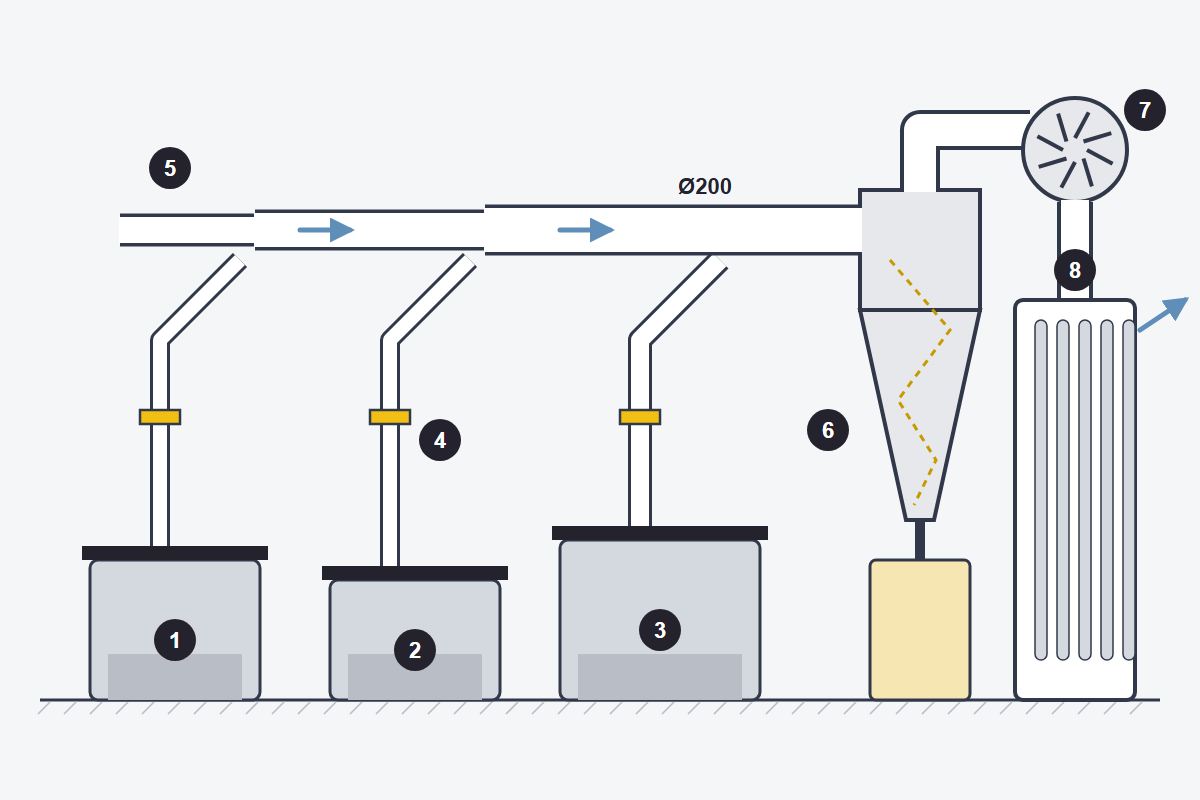
1 Saw · 2 Jointer · 3 Planer · 4 Blast gates · 5 Main duct · 6 Cyclone · 7 Fan · 8 Filter.
Dust collector: equipment that draws sawdust and chips from the port of each machine and carries them through ductwork to where they are discharged. That is the textbook definition. In a real woodshop, the dust collector tends to be the last thing bought and the first thing to fall short, because it gets chosen by the horsepower printed on the box rather than by the air the machines need.
Here is the math in the opposite order, starting from the machines. At the end comes the comparison we get asked about most, a portable bag unit against a central cyclone system.
Chips and sawdust stay airborne in the duct as long as the air moves fast. If the velocity drops, the material settles in horizontal runs and eventually plugs the line. For dry wood dust the design conveying velocity is around 20 m/s (about 3,900 ft/min), a bit higher for heavy or wet chips.
The simplest way to tell how much air a machine needs is to look at its dust port, because the manufacturer sized it for the chips the machine makes. Airflow is the port area times the velocity. Port sizes vary by model; the table shows common examples.
| Port | Airflow at 20 m/s | Where it usually appears |
|---|---|---|
| 100 mm (4") | 565 m³/h (333 CFM) | Table saw, jointer, band saw |
| 125 mm (5") | 884 m³/h (520 CFM) | Shaper, mid-size planers |
| 150 mm (6") | 1,272 m³/h (749 CFM) | Large planers, wide-belt sanders |
| 200 mm (8") | 2,262 m³/h (1,331 CFM) | Main duct of a small shop |
If a machine has two ports, add them up.
A woodshop with six machines does not need air for all six, only for the ones running at the same time. How often in a day are the saw, the jointer and the planer actually running together? If the answer is almost never, the system is sized for two, and every branch gets a blast gate that is closed while that machine sits idle. Without gates the air escapes through open ports that do not need it, and the machine that is working gets half.
Airflow is half the calculation. The other half is the pressure the fan has to overcome, adding up friction in the ducts, the elbows, the hose, the cyclone and the filter. Corrugated flex hose loses the most per meter, so it belongs on the short runs that connect each machine to rigid duct, never on runs across the shop.
In a small system, with 15 to 20 meters of duct, a cyclone and a filter, a total around 2,000 Pa (about 8 inches of water) is a reasonable figure. We take it as an assumption for the examples below; every installation is calculated with its own layout.
The power the fan delivers to the air is airflow times pressure. The motor has to supply more, because the fan has its own efficiency, and for this kind of unit we use 60 %. On top of that we add a 15 % service margin. With those numbers:
Going from one machine to three almost doubles the motor. That is why how many run together matters more than the list of machines in the shop. The full calculation, with efficiency by impeller type and cold starts, is in our guide to centrifugal fan power.
A good fan on bad ductwork performs like a small one. The main duct grows in diameter as branches join it, so the velocity stays even, and each branch comes in from the side at 30 to 45 degrees, never as a 90-degree tee, because the two streams colliding slow the air down. Elbows should be long-radius. Horizontal runs, only as long as necessary, with a cleanout in case one day it loads up.
Wood dust is also combustible. In a central system, use metal duct bonded to ground so static does not spark, and put the large filter outside the shop when you can.
The portable bag unit is the 1 or 2 HP machine you see in nearly every small shop, a fan on wheels with one cloth bag on top and another below. It is cheap, it moves from machine to machine, and with a short hose it does well for one machine at a time. It has two limits. Chips go through the impeller, so the impeller must be a rugged paddle type, which is less efficient. And the cloth bag on cheaper units holds chips and coarse sawdust but lets part of the fine dust through, which is exactly the part you breathe.
The central cyclone system has fixed ductwork, with a branch and a blast gate per machine. The cyclone separates the chips before the fan and drops them into a bin, so the fan sees nearly clean air and can use a more efficient impeller. What the cyclone does not catch, the finest dust, is held by a baghouse or cartridge filter. It costs more and takes up room, but it grows with the shop, since adding a machine means adding a branch. What separates a good cyclone from one that only makes noise is covered in cyclone or baghouse.
If your shop runs one machine at a time, with ports up to 125 mm, a 2 HP portable with a good bag or cartridge is enough, always with the hose as short as possible. If two or more run together, if there is a large planer, or if the shop is long, the central cyclone system is the one that will not fall short. There is a gray area in between: a three-machine shop that nearly always uses one can start with a portable and move to a central system as it grows. What does not pay is running fixed 100 mm duct through the whole shop, which is useless for anything bigger later.
The International Agency for Research on Cancer has classified wood dust as carcinogenic to humans since 1995. That makes the filter as important as the motor. The sawdust on the floor is a nuisance; the fine dust floating at face height is what does the harm, and it is what escapes from a poor bag. How to split the air between branches and choose each diameter, with the full method, is in our guide to sizing a dust collection system.
When a dust collector shows up on sale with its horsepower in big letters, look in the spec sheet for the airflow at a stated pressure and for what the filter holds back. If it does not say, there is no way to know whether it suits your shop. And if you would rather have it worked out for your machines, at Indumor we build cyclones for chips and sawdust, fans and filters to order.
Send us the machine list, which ones run together and the shop length, and we will propose the system.
© Indumor 2010–2026 — Industrial steel fabrication, Córdoba, Argentina
