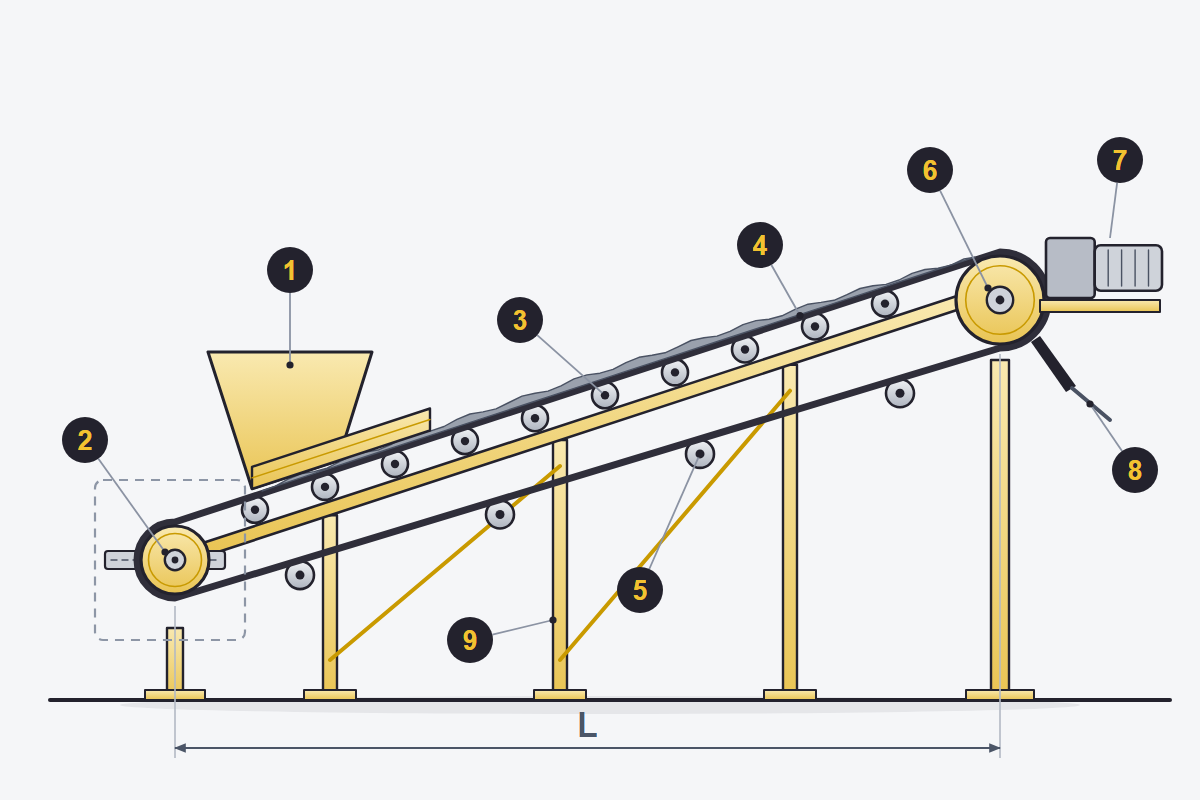
1 loading hopper with skirts · 2 tail pulley with take-up · 3 troughing idlers · 4 belt · 5 return idlers · 6 drive pulley · 7 gearmotor · 8 belt scraper · 9 support stand · L pulley centers.
How many suppliers will you have to get on the same page before your conveyor starts up? The one for the structure, the belt, the idlers, the gearmotor, the shop that turns the pulleys and the crew that installs it. Six phone calls for every part that doesn't fit.
At Indumor we build the complete belt conveyor at our plant in the Ferreyra industrial area of Córdoba, Argentina. We fabricate the frame, the support stands, the drive, tail and snub pulleys, the take-up, the guards, the loading hoppers and chutes with their skirts, and the walkways. The belt, the idlers, the gearmotor and the scrapers are bought in, and we install them ourselves.
Request a quoteSame-day quote, at factory-direct prices.
The conveyor structure comes from one shop, the belt from a distributor, the idlers from someone else and the gearmotor from whoever has one in stock. Each purchase makes sense on its own. The trouble shows up on installation day, with an idler set that won't sit on the stringer or a take-up that runs out of travel before the belt is tight.
And the week lost to fitting and adjusting, who do you bill for that? Each supplier answers for their own part, and their own part arrived fine.
Belt width drives everything. The width and the belt set the idler roll length, the frame and the pulley diameters. The design manual of a European belt manufacturer calls for a drive pulley of about 108 times the carcass thickness on a polyester belt.
We buy the components for that size, turn the shafts and hubs, and assemble on jigs.
Our take: if the conveyor already exists and what failed is the structure, order the structure alone. If the conveyor is new, have it built complete, with one drawing and one party in charge from the tail pulley to the scraper. The belt doesn't read invoices.
Overland mining conveyors, the ones that run for kilometers, we take on as structure and installation. Where all of this came from is told in the history of the conveyor belt.
Belts from 400 to 1,400 mm wide and up to about 100 m long inside a plant, to your drawing or to the space it goes in. Anything bigger, ask us.
Using the ISO 5048 calculation method, a 1,000 mm belt on 35° troughing idlers, with a 20° surcharge angle, carries a cross section of about 0.11 m². At 1 m/s that is roughly 400 m³ per hour, as an indicative capacity. The belt width and capacity chart has the other widths, and the belt conveyor calculator (in Spanish) runs the numbers for your material. Troughing is explained in the industrial belt conveyor guide.
The catalog of a European idler manufacturer uses a screw take-up up to 30 or 40 m between centers; longer than that, a gravity take-up.
We don't build the electrical control panel or the automation. The plant's electrician or integrator handles that, and we coordinate with them: we tell them where the gearmotor goes and how much power it draws.
Concrete footings aren't ours either. We give you the support dimensions of each stand for whoever pours them.
Our shop already turns out conveyor structures and transfer chutes; a complete conveyor is the same trade plus pulleys, take-up and installation. How we think about the structure is in the conveyor structures guide. Give us the material, tons per hour, length and lift, and we put together the takeoff.
A plant layout helps. Without one, the distance between pulleys and the height to climb are enough for a first takeoff.
Same-day quote, at factory-direct prices.
© Indumor 2010–2026 — Industrial steel fabrication, Córdoba, Argentina
