November 27, 2026 · Indumor
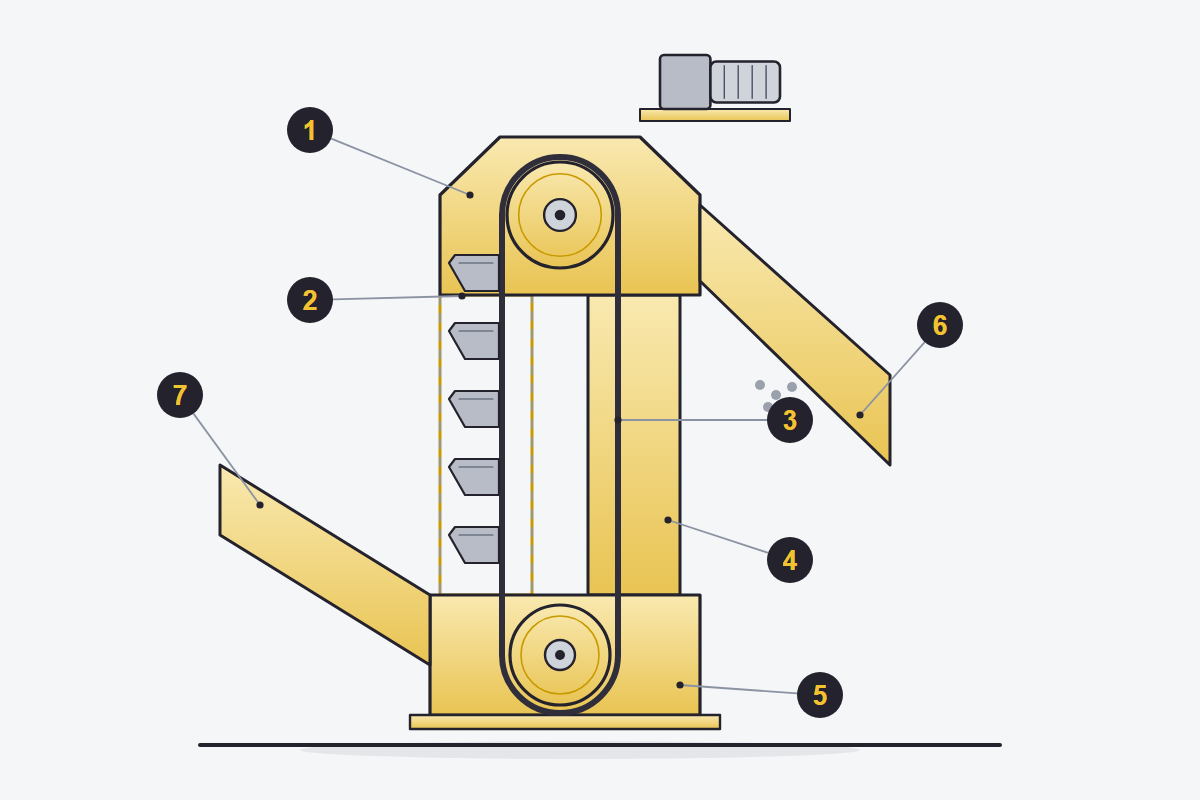
1, head with drive pulley; 2, buckets; 3, belt; 4, casing leg; 5, boot with tail pulley; 6, discharge; 7, inlet.
Harvest, late at night, and there's a line of trucks in the grain elevator yard, headlights on, waiting their turn. The first one opens its gate over the grate, the corn drops into the pit, and from the boot the bucket elevator lifts it up to the head, the tallest thing on the site. Up there the grain gets flung into the discharge spout and heads off to the bin. It's the machine everybody sees from the road and nobody thinks about until it stops.
A bucket elevator is an endless belt or chain with buckets, running between a tail pulley in the boot and a drive pulley in the head, enclosed in casing legs or a box. Four keys.
A head held together with baling wire holds out until harvest, which is exactly when you can't shut it down.
In one line: the head pulley sets the speed, and the speed decides how the bucket empties. Send us the lift height, the material and the tons per hour, and we'll build the elevator together with the belt conveyors that feed it.
Sources: centrifugal discharge when centrifugal force equals weight, Garofoli, Revista Iberoamericana de Ingeniería Mecánica (UNED), 2014; rpm, speed and pole distance using the pulley radius (n = 42.3/√D, v = √(g·D/2), h = 895/n²), our own calculation from that approach; discharge classification by pole distance, from document IIT-97-044A of Universidad Pontificia Comillas; speeds of 1.1 to 2.5 m/s and half that for non-centrifugal elevators, from a US manufacturer's guide, not linked.
Give us the height, the material and the flow, and we send back the steel takeoff in kilos for head, boot and legs, with a same-day quote.
© Indumor 2010–2026 — Industrial steel fabrication, Córdoba, Argentina
