November 2, 2026 · Indumor
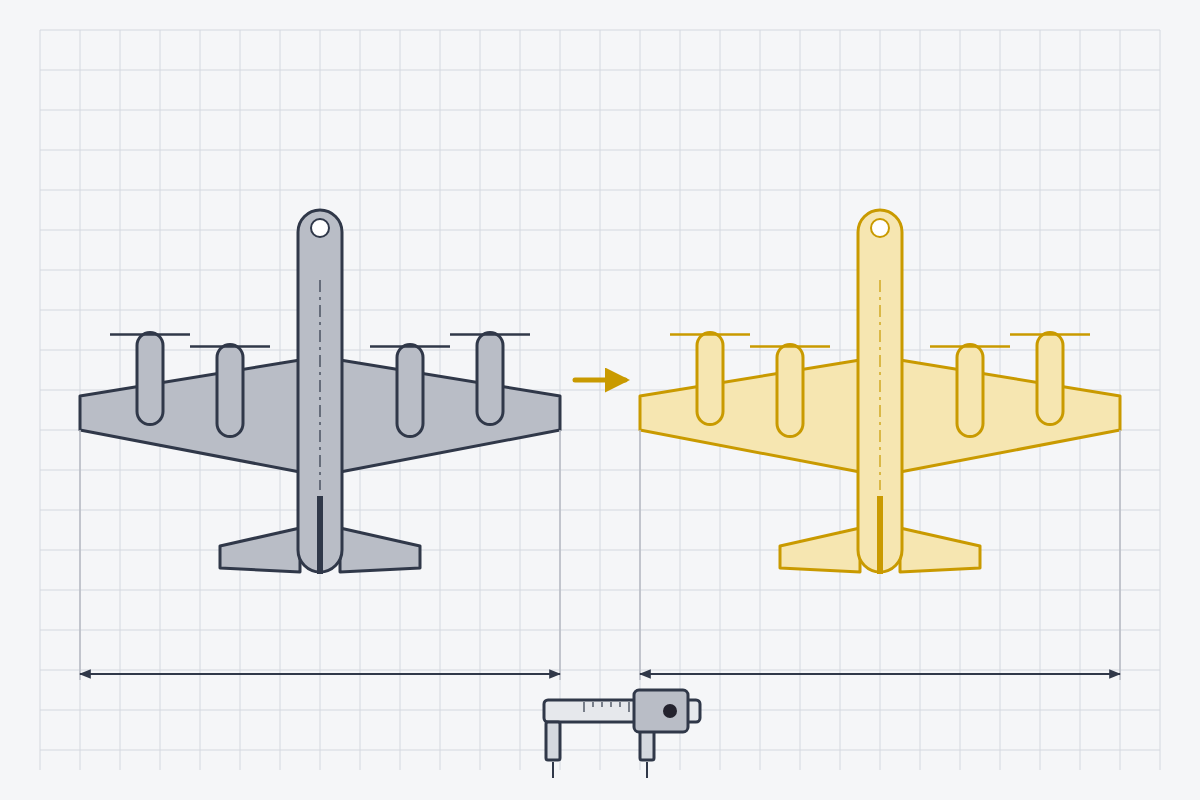
The original in grey and the copy in amber: two four-engine aircraft in plan view, like the B-29 and the Tu-4.
One hundred and five thousand parts measured and photographed, some forty thousand drawings, nine hundred factories and institutes, and two years of work on three aircraft that belonged to someone else. That was the size of the copy of the Boeing B-29 that the Soviet Union made between 1945 and 1947 and flew as the Tupolev Tu-4. It is the largest case of reverse engineering on record. It was not the first.
Before it, two men crossed the Atlantic with whole machines in their heads. Samuel Slater left England in 1789, when the law forbade textile workers to emigrate and forbade taking machines or drawings out of the country, and by December 1790 he had the first cotton spinning machine ever to work in the United States running in Rhode Island, rebuilt from memory. Twenty years later the merchant Francis Cabot Lowell toured the mills of Lancashire, memorized the English power loom and by 1814 had it running in Waltham. Three copies, three new industries.
Slater was born in Belper, Derbyshire, in 1768. At fourteen he signed his indenture with Jedediah Strutt, the partner who had financed Richard Arkwright, and worked for him until he was twenty-one. Arkwright's patent had been voided in 1785, but Parliament guarded that advantage another way: since 1719, with ever harsher laws in 1750, 1774 and 1781, textile artisans could not emigrate, and machines, tools and drawings could not leave the country.
In September 1789, without telling his family and with his apprenticeship papers hidden, dressed, as the tradition has it, as a farm laborer, Slater boarded a ship for New York. There a ship's captain told him that in Pawtucket, Rhode Island, the Quaker Moses Brown could not get his spinning machinery to work. In January 1790 Slater looked at those machines and proposed building them again. He did not have a single drawing. He rebuilt Arkwright's carding engine and spinning frame from memory, with a local carpenter and two blacksmiths, and worked out the gear speeds in his head. On December 20, 1790, in rented space inside a fulling mill, that machine spun the first machine-made cotton yarn in the United States. The building visited today as Slater Mill dates from 1793.
In Belper they called him "Slater the Traitor". In the United States, President Andrew Jackson called him, in 1833, the "father of American manufactures". He formed thirteen textile partnerships and died in 1835 in Webster, Massachusetts, the town he had founded around his mills. He had carried an industry away in his memory.
Lowell was no mill hand but a Boston merchant. In 1810 he sailed to Britain, for his health and because the Napoleonic wars were wrecking his shipping trade, and went to Manchester to find out everything he could about cotton and the power loom. He got into mills closed to Americans on letters of introduction and the standing of a Boston merchant, not in disguise. Buying drawings or models was out of the question, because exporting them was still illegal, so he studied how the English power looms worked and kept the essentials in his head. The story goes that on his return in 1812 British agents searched the family's baggage and found nothing.
In 1813 he founded the Boston Manufacturing Company with his brother-in-law and a group of investors, and hired a mechanic from Amesbury, Paul Moody, who built the loom from what Lowell remembered and calculated. In the autumn of 1814 it worked. The Waltham mill was the first in the United States with the whole process under one roof, from bale to cloth, at a time when England spun in one mill and wove in another. Lowell died in 1817, at 42. His partners later built a textile city on the Merrimack and incorporated it in 1826 under his name.
The Soviet Union had asked for B-29s under Lend-Lease and Washington refused twice. The aircraft came on their own. Between July and November 1944, four B-29s damaged over Japan and Manchuria made for Soviet territory: three landed near Vladivostok and one crashed after its eleven crewmen bailed out. Because the USSR was still at peace with Japan, the aircraft were interned, and so were the crews, until in January 1945 the NKVD staged an escape to Iran so as not to provoke Tokyo.
In June 1945 a decree of the State Defense Committee ordered Andrei Tupolev's design bureau to copy the B-29 and cancelled his own project. One aircraft was taken apart piece by piece, another was used for flight tests and the third was kept intact as a reference. Some 900 factories and institutes measured close to 105,000 parts and subassemblies, and about a thousand draftsmen produced some 40,000 drawings.
The underlying problem was the one this trade always faces: the original was in other units. The B-29's sixteenth-of-an-inch sheet, 1.5875 millimeters, was not rolled in the USSR; thicknesses from 0.8 to 1.8 millimeters were used instead, and every part was recalculated to decide whether it went thicker or thinner. New alloys and gauges had to be put into production. Not everything was copied: the engines were the Shvetsov ASh-73TK, from a line descended from the Wright Cyclone built under license in the 1930s, although their turbochargers were copied from the B-29's. Leonid Kerber, Tupolev's deputy, titled his memoir of the program "Not a copy, but an analogue".
The first Tu-4 took off on May 19, 1947, with Nikolai Rybko at the controls, and according to the historians Gordon and Rigmant the prototype weighed less than 1 percent more than the original. On August 3, at the Tushino air parade, three Tu-4s flew past; Western observers at first took them for the interned B-29s, until a fourth aircraft appeared, the Tu-70 airliner, which did not exist in the United States. The reference figure is 847 built through 1952. The copy forced Soviet industry to make sheet, alloys and equipment it did not have.
The three stories end the same way: the copy taught more than the machine did. Slater's mills produced a system of factories; Waltham, the integrated-mill model that gave birth to the city of Lowell; the Tu-4, an industry that learned to make what it did not know how to make. There were copies closer to our home, too: in Córdoba, from 1952 the state firm IAME developed the Puma motorcycle from a near-exact copy of the German Göricke, according to the book by Facundo Picabea and Hernán Thomas.
What has changed is the legal frame. The United States Supreme Court held in 1974, in Kewanee Oil v. Bicron, that trade secret law gives no protection against reverse engineering by fair and honest means, and in 1989, in Bonito Boats v. Thunder Craft, that what is not patented may be copied. In Argentina, the patent law 24,481 and the confidentiality law 24,766 do not even name reverse engineering: the limits are set by patents in force, which last twenty years, by registered models and designs, by contracts and by secrets obtained dishonestly. The details are in what you can legally copy. The lesson of all three stands untouched: copying is not measuring. What it is instead is what how a machine is copied and measuring with calipers and a 3D scanner are about.
A typical case in our plant: a machine imported in the 1990s, its maker gone and no spare parts to be had. It is surveyed in position, stripped with every part tagged, the parts that cannot be bought are drawn, and a second unit is built with known steel and a new control system. At Indumor that work is done end to end in Córdoba, Argentina, and reverse engineering explains how we do it.
Sources: A. Welles, "Father of Our Factory System", American Heritage (1958); National Park Service, Blackstone River Valley and Lowell; Belper North Mill; D. J. Jeremy, Business History Review (1977); W. J. Boyne, Air & Space Forces Magazine (2009); Y. Gordon and V. Rigmant, Tupolev Tu-4 (2002); L. Kerber and M. Saukke, Krylya Rodiny (1989); Cornell LII, Kewanee v. Bicron and Bonito Boats v. Thunder Craft; InfoLEG, Laws 24,481 and 24,766; F. Picabea and H. Thomas (2015), reviewed in Redes (2016).
We survey, model and build the copy or the spare part.
View service →From teardown to drawing and from drawing to copy, step by step.
Read guide →Send us photos and dimensions: we will tell you whether to copy it, improve it or make only the spare parts.
© Indumor 2010–2026 — Industrial steel fabrication, Córdoba, Argentina
