November 24, 2026 · Indumor
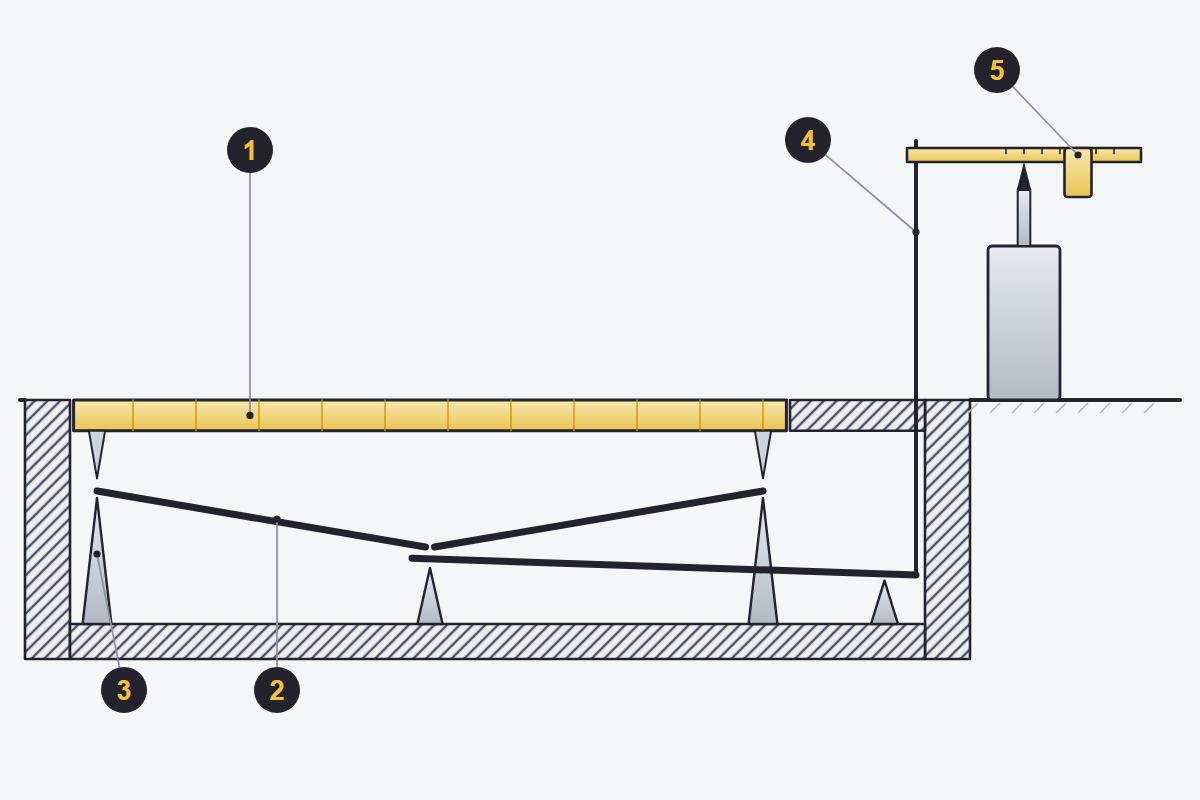
1, platform; 2, levers; 3, fulcrums; 4, rod; 5, steelyard beam with poise.
Who invented the truck scale? Strictly speaking, nobody, because there were no trucks when it showed up. There were carts loaded with hay, coal or hemp, and the same problem at every gate: finding out what they carried without unloading them.
The first push came from the roads. An English act of 1741 opens by saying excessive weights were ruining the kingdom's highways. From September 29 that year, turnpike gates could put up a "machine" to weigh carts with their loads and charge 20 shillings for every hundredweight over sixty, about three tons.
The machine was close at hand. In Birmingham, John Wyatt built what was probably the first compound-lever platform scale in the early 1740s. London's Science Museum keeps a scale model, horse and cart included, of the one he made for the parish, dated 1741.
Almost a century later, Thaddeus Fairbanks was running a hemp company in St. Johnsbury, Vermont. Growers brought in their loads and the company weighed them hung from beams, on scales so rough it was hard to know what to pay each man. Fairbanks put the whole cart on a platform.
The year depends on who you ask. The town's historical marker says 1830. The patent you can read today, US 118, is dated February 10, 1837, signed by Erastus and Thaddeus, and cancels two earlier ones for a defective specification, one from June 1831 (the scan is half garbled) and one from March 1834. By then the brothers had already formed E. & T. Fairbanks to build it.
The patent describes a plank platform about nine by twelve feet. Each corner has a hinge with two knife edges, one resting on the fulcrum and the other carrying the platform. The levers tie the four corners together and a rod takes it all up to the steelyard, which with a 60-inch arm read one tenth of the weight. The cart could stand anywhere, because all four corners pulled equally. That's what the drawing shows.
With the railroads, the levers grew. The US Bureau of Standards started looking into railroad track scales in 1913. By 1930 it described its method: the test weights rode on a small truck that an electric motor moved slowly and evenly, "practically without impact," so the scale parts wouldn't shift during the test.
In 1925 it published the railroads' specifications for motor truck scales of 20,000 to 40,000 pounds, for 3½ to 7½ ton trucks, all lever scales. The weighbridge was already made of steel girders, designed like a railroad bridge with an allowance for impact and riveted in the shop. The deck could still be creosoted timber.
Between November 1936 and May 1938 the Bureau's testing unit worked through sixteen states with its weights. Of 967 wagon and motor-truck scales, only about 2 in 9 weighed within tolerance, and the average maximum error came to six times the allowance. In 44 percent the pit was dirty, sometimes with the levers "literally buried" in dirt or coal. One had a track hanging off the end to weigh long vehicles on a short scale. And many new ones, the report says, were handed over badly installed, which our guide on foundations and ramps picks up.
One habit from back then is still worth breaking, running more weight over the scale than it was built for. Makers said not to weigh truck loads over 60 percent of capacity on a wagon scale, and 63 percent of the 433 wagon scales tested were past that. The record was a 12,000-pound scale weighing 10,000-pound loads. Its close cousin is the driver who comes in fast and stands on the brakes on the deck. If the Bureau tested without bumps, it was because a bump shifts the parts.
The part that retired the levers came from somewhere else. In 1936, at Caltech, Edward Simmons came up with the bonded wire strain gauge. In April 1938, at MIT, Arthur Ruge was trying to measure the stress an earthquake puts into water tanks and reached the same idea on his own. They shared the patent, the trade name SR-4 comes from their surnames, and the first big sale, 50,000 gauges, came in 1941.
A load cell is a piece of steel with gauges bonded to it; the weight strains it a hair and the gauge turns that into an electrical signal. The deck sits right on the cells, and the levers and the steelyard go away. When did that reach truck scales? We couldn't find a date with a solid source, and we'd rather not make one up. What is on record is that in 1938 one in four of the scales the Bureau tested already had a dial or automatic indication, with the levers still down below.
The steel part is still there: plate on beams, sitting on load cells instead of knife edges, as we explain in how a truck scale works. And the 1938 problems, mud under the deck, water with nowhere to go, sloping approaches, are the ones covered in truck scale maintenance.
In our shop we build that structure. We laser-cut the plate, bend on CNC press brakes, assemble the modules on jigs so each one comes out like the next, and MIG weld them. The load cells, the indicator and the scale setup come from the scale company, and we coordinate with them. If the scale company has its own deck drawings, we build to those drawings.
If you need the steel for a truck scale, ask Indumor for a quote on the deck modules, ramps and load cell mounts, with the length, width and capacity your scale company calls for.
Sources: English highways act of 1741 (14 George II c. 42); Science Museum Group, model of John Wyatt's cart-weighing machine, object 1930-715; Grace's Guide, John Wyatt; US Patent 118, E. and T. Fairbanks, 1837; St. Johnsbury historical marker; Thaddeus Fairbanks, citing newspapers from 1886 to 1955; Bureau of Standards, Letter Circular 295, 1931; Letter Circular 152, 1925; Letter Circular 529, 1938; J. S. Dietrich, "Simmons and the Strain Gauge," Engineering and Science 50(1), Caltech, 1986; US Patent 2,292,549, E. E. Simmons, 1942; Arthur C. Ruge, with his New York Times obituary of 2000.
Send us the sizes or the scale company's drawings. We build the deck modules, ramps and load cell mounts and get you a same-day quote.
© Indumor 2010–2026 — Industrial steel fabrication, Córdoba, Argentina
